Crawlspace Mold vs Mildew: What’s the Real Difference?
A central Ohio crawl space specialist’s guide.
- Licensed & Insured in Ohio
- Locally Owned, Columbus-Based
- 25-Year Warranty on Encapsulation
- Free On-Site Estimates
- 0% Financing Available
Homeowners in the Columbus metro use the words “mold” and “mildew” almost interchangeably when they describe what they’re seeing in their crawl spaces. The distinction matters considerably more than most people realize. Mildew is a specific kind of fungal growth — typically powdery, white or gray, surface-only — that responds to simple cleaning and a moisture control fix. Mold is a broader category that includes several genera (Aspergillus, Penicillium, Cladosporium, and Stachybotrys among them) and which often penetrates beyond the surface into porous substrates like wood and fiberglass. The remediation approach is fundamentally different. Here’s what to know if you’re trying to figure out what you’ve got in your central Ohio crawl space.
What Mildew Actually Is
Mildew, in homeowner usage, typically refers to early-stage surface mold growth — particularly white, gray, or pale yellow colonies on hard surfaces like foundation walls, the undersides of joists, and concrete pier blocks. In the strict botanical sense, mildew is a plant-pathogenic fungus that grows on living plant tissue (powdery mildew, downy mildew), but in indoor environments the term usually describes surface fungal growth that hasn’t yet penetrated the substrate. Mildew is usually treatable with a household cleaner, doesn’t dig into the wood, and doesn’t typically produce significant mycotoxins.
What Mold Actually Is
Mold is a broader category. In Columbus-area crawl spaces, the species we encounter most often are Aspergillus (typically green or yellow), Penicillium (blue-green), Cladosporium (olive-green to dark brown), and occasionally Stachybotrys chartarum (the famous “black mold”). Mold colonies on wood substrates penetrate into the material via root-like structures called hyphae — which means surface cleaning alone does not remove them. Several common species also produce mycotoxins as part of their metabolism, which is why professional mold remediation in residential spaces is regulated and requires specific PPE and containment protocols.
How to Tell Which You Have
Visual inspection is a useful starting point but not definitive. Powdery white or gray growth on hard surfaces (foundation walls, the undersides of joists) that wipes off easily with a damp cloth is usually mildew. Fuzzy, dark, or colored growth (black, dark green, brown, mustard-yellow) on wood, fiberglass, or porous materials that doesn’t wipe off is almost certainly mold. Persistent musty smells indicate microbial volatile organic compounds (mVOCs), which mold produces in much higher quantities than mildew. For a definitive species identification, an air or surface sample sent to an accredited lab returns results within 48-72 hours and is sometimes worth the modest cost if insurance is involved or if you have respiratory symptoms in the household.
Why It Matters in Central Ohio Crawl Spaces
The Columbus metro’s climate — average 75% summer relative humidity, glacial till subsoil that releases moisture year-round, freeze-thaw cycles that crack mortar and create new moisture pathways every winter — makes our crawl spaces hospitable to both mildew and mold. We routinely see surface mildew on hard foundation walls in spring and early summer, and we see deep mold colonies on floor joists in homes that have had moisture problems unaddressed for years. The remediation cost difference is significant — surface mildew responds to cleaning, improved ventilation, and a dehumidifier. Wood-penetrating mold requires HEPA-filtered containment, EPA-registered antimicrobial treatment, possibly material removal, and a documented remediation protocol acceptable to home inspectors and insurance adjusters.
The Remediation Difference
Mildew remediation in the Columbus metro typically involves: physical cleaning of the affected surface, application of a commercial-grade antimicrobial spray, improvements to ventilation and moisture control, and a follow-up inspection at 30 days to verify the cleaning held. Time on site: a few hours to a single day.
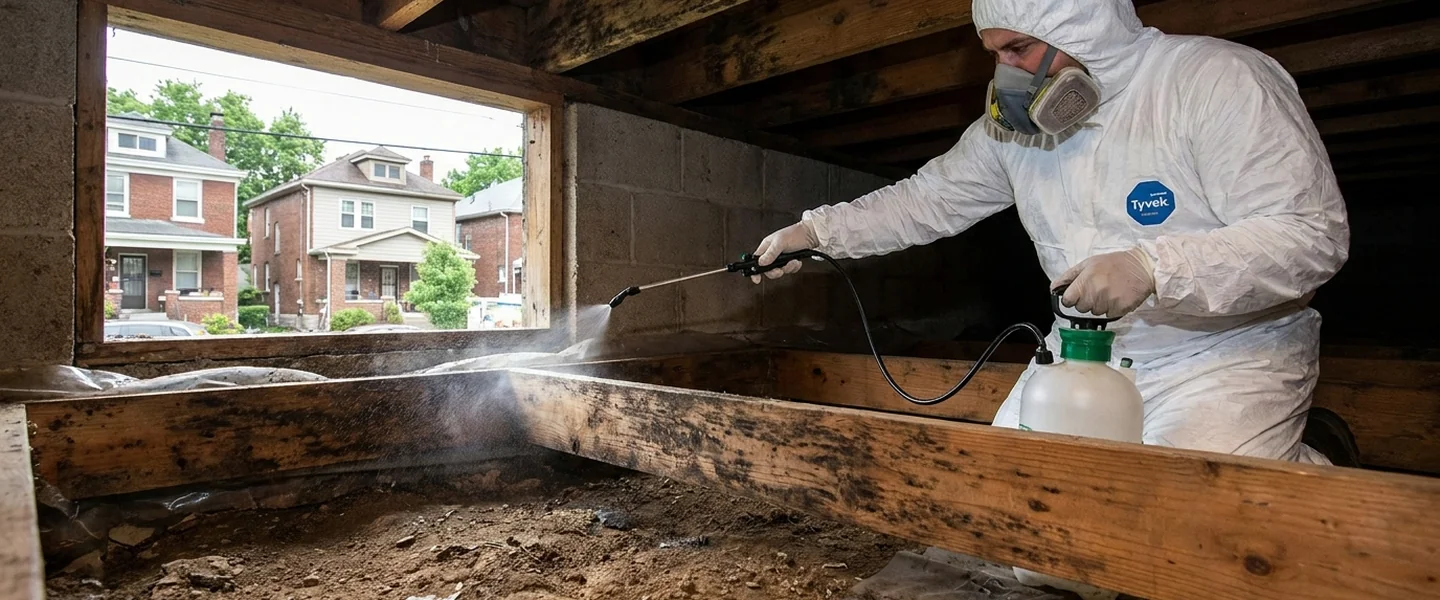
Mold remediation in the Columbus metro typically involves: HEPA-filtered negative-air containment to prevent spore migration into the conditioned living space, removal of contaminated porous materials (fiberglass batts, drywall, sub-flooring fragments in severe cases), EPA-registered antimicrobial treatment of all exposed wood surfaces, HEPA vacuuming of all surfaces in the containment area, application of a sealing primer where staining persists, post-remediation verification testing in some cases, and the underlying moisture-source elimination that prevents recurrence. Time on site: 1-2 days for moderate contamination, 3-5 days for severe contamination requiring joist or sub-floor replacement.
Why Cleaning Alone Doesn’t Work for Mold
Mold’s hyphae penetrate into porous materials like wood. Wiping the surface removes the visible colony but leaves the root structure intact, which then re-emerges as soon as humidity rises above ~60% RH again — which happens by mid-May every year in central Ohio. Household bleach is famously ineffective on porous surfaces: the water content of the bleach actually feeds the mold while the chlorine breaks down before penetrating deep enough to kill the hyphae. Effective mold remediation uses EPA-registered antimicrobial products specifically formulated to penetrate wood substrates, combined with physical agitation (wire brushing, sanding) to remove the colony entirely down to clean wood.
What to Do If You Find Suspect Growth
Do not touch it without an N95 respirator. Do not power-wash it (that aerosolizes spores throughout your breathing air and the rest of the home). Do not pour bleach on it (ineffective on porous substrates; the water content can actually worsen the problem). Do photograph it carefully, note the location and approximate affected area, and call a remediation specialist for a free inspection. If anyone in the household has allergies, asthma, or compromised immune systems, limit time in the crawl space until the source is addressed by a professional.
How Central Ohio’s Climate Drives the Remediation Decision
In drier climates, mildew sometimes responds to improved ventilation alone. In central Ohio, ventilating an unsealed crawl space adds humidity rather than removing it — outside summer air is wetter than inside crawl space air after dehumidification. The right answer for Columbus is almost always to seal the crawl space, dehumidify it, and address whatever active growth is present at the same time. Half-measures do not work in our climate, and a contractor who recommends “just add more vents” in central Ohio either doesn’t understand the climate or is selling a cheap fix that will fail.
Common Misconceptions About Crawl Space Mold
“If I can’t see it, it’s not there.”
Mold colonies on joists in unlit crawl spaces are routinely missed for years. By the time you can see it from outside the crawl space (visible discoloration on lower-floor trim, persistent musty smell upstairs), the colony is typically advanced and extensive.
“Bleach kills mold.”
Bleach is ineffective on porous substrates like wood — the chlorine breaks down before it penetrates the hyphae. EPA-registered antimicrobials formulated for the specific substrate are the right tool, and they’re what professional remediation crews actually use.
“I need to vacate the house during remediation.”
Usually not. Properly sealed HEPA containment isolates the crawl space from the conditioned living space, and most homeowners stay in the home during Columbus-area remediation jobs. Exceptions: severe contamination, remediation in a basement adjacent to the affected area, or households with immunocompromised members.
“It’ll take weeks.”
Moderate-scope crawl space mold remediation in the Columbus metro typically completes in 1-2 days. Severe cases (extensive joist replacement, multi-section crawl spaces in older Worthington or Upper Arlington homes) can run 3-5 days. Multi-week timelines suggest scope creep or a contractor who isn’t focused on residential crawl space work.
Bottom Line
If you’re seeing growth in your crawl space and you’re not sure whether it’s mildew or full mold, the safest path is to have it inspected by a Columbus-area specialist who can tell you what you’ve got, document it with photos and written report, and recommend a proportional remediation plan. Call (614) 907-4875 for a free 30-minute inspection. We’ll identify the growth, photograph the conditions, and deliver a written remediation plan within 24 hours.
Need a free inspection or a second-opinion quote review? Call (614) 907-4875. We serve Columbus and all surrounding Franklin County suburbs including Dublin, Westerville, Worthington, Hilliard, Upper Arlington, Grove City, Reynoldsburg, and Gahanna. Written estimates within 24 hours.
Related reading: Crawlspace Encapsulation Service Page | Crawlspace Mold Remediation Service Page | Dehumidifier Installation Service Page
Free Crawlspace Inspection in Columbus
Same-week appointments. No high-pressure sales. Serving Columbus and surrounding Franklin County suburbs including Dublin, Westerville, Worthington, Hilliard, Upper Arlington, Grove City, Reynoldsburg, Gahanna.