Crawlspace Vapor Barrier in Central Ohio: 6-mil vs 20-mil Reinforced
A central Ohio crawl space specialist’s guide.
- Licensed & Insured in Ohio
- Locally Owned, Columbus-Based
- 25-Year Warranty on Encapsulation
- Free On-Site Estimates
- 0% Financing Available
Vapor barrier thickness is the single most-asked question we get from Columbus homeowners comparing crawl space encapsulation quotes. One contractor’s quote specifies “6-mil polyethylene.” Another contractor’s quote specifies “20-mil reinforced Stego Wrap.” The cost difference is meaningful, but the performance difference over a 25-year lifespan in central Ohio’s climate is dramatically larger. Here’s an honest, contractor-perspective comparison of 6-mil vs 20-mil reinforced vapor barrier installations for Columbus-area crawl spaces.
What 6-mil Polyethylene Actually Is
6-mil polyethylene is the same black plastic sheeting you can buy at any big-box home-improvement store in the Columbus metro. It’s manufactured as a continuous film, with no reinforcement, in 10-foot or 20-foot widths. It’s the bare-minimum material specified by the original International Residential Code for ground-cover vapor retarder in crawl spaces, and for that purpose — protecting against ambient soil moisture vapor — it works on day one. The problem is that it doesn’t last. In central Ohio’s humidity / freeze-thaw cycle, 6-mil polyethylene starts breaking down at seam edges within 3-5 years, develops pinholes from foot traffic and dropped tools within 5-7 years, and is functionally compromised within 10-15 years of install.
What 20-mil Reinforced Vapor Barrier Actually Is
20-mil reinforced vapor barrier — most often Stego Wrap in the materials we install — is engineered specifically for sealed crawl space and below-slab applications. It’s manufactured with a polyethylene core that’s 20 mils thick (more than three times the thickness of 6-mil), plus a woven polyester scrim layer mid-sheet that gives it tear resistance comparable to a building-wrap. Stego Wrap carries a 25-year manufacturer warranty against material defects when installed per their spec, and the field history across the southeastern and midwestern US shows installations that are still performing at 15+ years with no measurable degradation.
The Performance Difference in Central Ohio’s Climate
The Columbus metro is a particularly brutal test environment for crawl space vapor barriers. Summer humidity drives 70-80% RH conditions for 12-16 weeks straight from June through September. Winter freeze-thaw cycles flex the foundation walls and the soil under the crawl space 35-50 times per year. Glacial till subsoil holds soil moisture year-round, creating constant vapor pressure against any barrier laid on it. In this environment, 6-mil polyethylene fails sooner than the national average, and 20-mil reinforced barrier performs as engineered.
The Cost Comparison Over a 25-Year Window
On day one, the material cost difference between 6-mil polyethylene and 20-mil reinforced barrier is meaningful but not catastrophic — typically a fraction of total project cost. Labor to install both is similar. Over a 25-year window, the cost picture inverts: the 6-mil installation typically needs to be torn out and re-installed twice (around year 10 and year 20), with associated demo costs, disposal, and any mold remediation needed because the failed barrier allowed moisture back into the crawl space. The 20-mil reinforced installation typically performs through the 25-year window without re-installation. We’ll quote both options honestly when asked, but we tell every Columbus homeowner that the 20-mil option is the better long-term value in central Ohio’s climate.
How to Tell What’s Actually Specified in a Quote
A vague quote line item that says “vapor barrier installation” without a specified thickness or product brand is hiding something. Real quotes specify the product (Stego Wrap, Layfield, or another named premium brand), the thickness (6-mil, 10-mil, 12-mil, 15-mil, or 20-mil), and whether the material is reinforced with a scrim or unreinforced. Ask any contractor in the Columbus metro to put those specifics in writing before you sign.
The Seam Detailing Difference
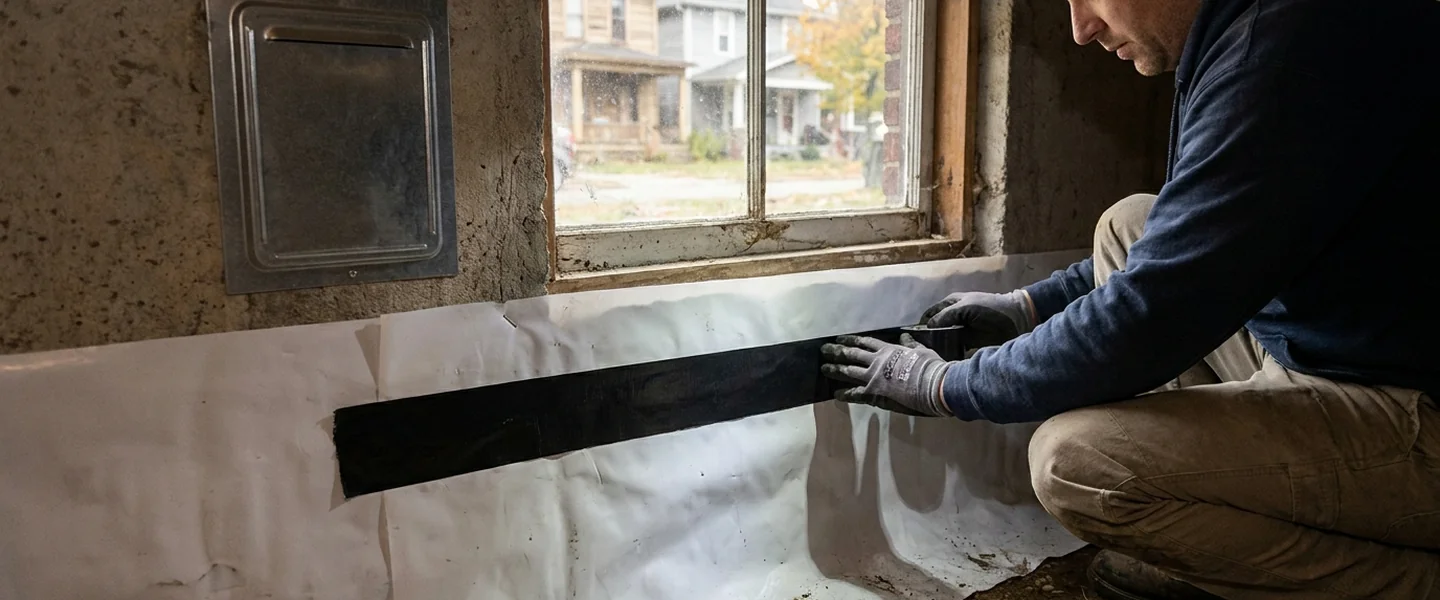
Material thickness alone isn’t the only factor. The seam-detailing approach is just as important. 6-mil polyethylene seams are typically overlapped a few inches and taped with whatever tape is in the truck — often standard duct tape that releases its adhesion within 18 months in a humid crawl space. 20-mil reinforced barrier seams are overlapped per manufacturer spec (typically 6+ inches), taped with manufacturer-approved butyl tape engineered for the substrate, and sometimes mechanically fastened in addition to taping. The 20-mil approach holds its seams for the life of the warranty; the 6-mil approach typically does not.
Wall Coverage and Pier Detailing
A 6-mil installation typically stops at the soil — the floor is covered, but the walls and piers are not. A proper 20-mil installation continues the barrier 6-12 inches up the foundation walls, wraps around every pier (limestone, brick, CMU, or poured concrete), and is sealed at every transition. The difference in moisture management performance over a central Ohio summer is substantial.
Termite Inspection Considerations in Ohio
Ohio has subterranean termite activity, though significantly less pressure than southern states like Tennessee or Virginia. Most central Ohio building departments still require a 4-6 inch termite-inspection gap at the top of any wall vapor barrier coverage so a pest-control inspector can see the wall above the barrier. A 20-mil reinforced installation respects this gap as part of the engineered install spec; a budget 6-mil installation often misses it entirely, which can create permit problems or future termite inspection issues at resale.
When 6-mil Actually Makes Sense
We’ll be honest: 6-mil polyethylene has some legitimate uses. As a temporary covering during construction or renovation, or as a starter solution for a rental property where the owner expects to sell within 5 years, it’s a defensible choice. For a long-hold Columbus-area homeowner who plans to live in the home for 10+ years, or who wants the warranty terms that come with a quality installation, the 20-mil reinforced option is the right answer almost every time.
What the Warranty Difference Looks Like in Writing
The 6-mil polyethylene from a big-box store typically carries no manufacturer warranty for crawl space use — it’s sold as a “vapor retarder” for general use, not as a crawl space barrier system. The contractor’s workmanship warranty on a 6-mil install is usually 1-3 years if it exists at all. The 20-mil reinforced Stego Wrap carries a 25-year manufacturer materials warranty when installed per Stego’s spec, and our workmanship warranty on the install is 10 years and transferable to a new homeowner. At resale, the documented 25-year transferable warranty is worth real money in the appraisal and the buyer’s confidence.
Columbus-Specific Considerations
The mix of pre-war character homes (Worthington, Upper Arlington, Westerville Uptown) and modern subdivisions (Dublin, Hilliard, Gahanna) means the right vapor barrier choice depends partly on the home. Pre-war homes with stone or brick piers have more complex pier detailing requirements, which makes the better material almost mandatory — 6-mil simply doesn’t have the tear resistance to hold up to the pier detailing work over time. Modern subdivision homes with poured-concrete piers can technically be done with either material, but the long-term economics still favor 20-mil reinforced.
Common Misconceptions
“6-mil is fine because it’s what the building code says.”
The code minimum is exactly that — a minimum, written for new construction with intact foundation walls. Real-world retrofit installations in Columbus-area crawl spaces with 50-100 year old housing stock need better than code-minimum to perform.
“Thicker just means more expensive without performance benefit.”
Wrong. The thickness is doing real work — tear resistance, puncture resistance, longevity. The polyester scrim in reinforced products is engineering, not marketing.
“Stego Wrap is just a brand name; it’s the same as any 20-mil.”
Mostly true at the material level, but the warranty terms and the install spec matter. Stego’s 25-year warranty is contingent on installation per their published specifications, and that consistency of spec is part of what makes the warranty enforceable.
Bottom Line
For a Columbus-area homeowner planning to stay in the home for more than 5 years, 20-mil reinforced vapor barrier is the right choice in central Ohio’s climate. The day-one cost difference is small relative to total project cost, and the 25-year performance and warranty difference is dramatic. Call (614) 907-4875 for a free 30-minute on-site inspection — we’ll specify exactly what we’d recommend for your specific home in the written estimate.
Need a free inspection or a second-opinion quote review? Call (614) 907-4875. We serve Columbus and all surrounding Franklin County suburbs including Dublin, Westerville, Worthington, Hilliard, Upper Arlington, Grove City, Reynoldsburg, and Gahanna. Written estimates within 24 hours.
Related reading: Crawlspace Encapsulation Service Page | Crawlspace Mold Remediation Service Page | Dehumidifier Installation Service Page
Free Crawlspace Inspection in Columbus
Same-week appointments. No high-pressure sales. Serving Columbus and surrounding Franklin County suburbs including Dublin, Westerville, Worthington, Hilliard, Upper Arlington, Grove City, Reynoldsburg, Gahanna.