Encapsulation vs Closed Crawl Space: What’s the Difference in Central Ohio?
A central Ohio crawl space specialist’s guide.
- Licensed & Insured in Ohio
- Locally Owned, Columbus-Based
- 25-Year Warranty on Encapsulation
- Free On-Site Estimates
- 0% Financing Available
“Encapsulation” and “closed crawl space” are terms central Ohio homeowners hear from different contractors, and the meanings are often used inconsistently across the industry. Some contractors use the terms as synonyms. Others use “closed crawl space” to mean a less expensive package without active humidity control. Still others use “encapsulation” to mean a high-end package with specific brand names attached. This post lays out the actual technical distinction, what each approach delivers in central Ohio’s climate, and how to read between the lines of a quote that uses either term.
The Technical Distinction
In strict industry usage:
A closed crawl space is one where the vents to the outside have been sealed, the soil has been covered with a vapor barrier, and the space is no longer “open” to outdoor air. The closed crawl space can be conditioned in one of three ways: (1) supply air from the home’s HVAC system delivered into the crawl space, (2) exhaust air pulled from the crawl space to the outside, or (3) a stand-alone dehumidifier maintaining humidity. The minimum closed crawl space install typically includes 6-mil polyethylene on the floor, vent sealing, and a passive approach to humidity (typically option 1 above — bleeding HVAC supply air in).
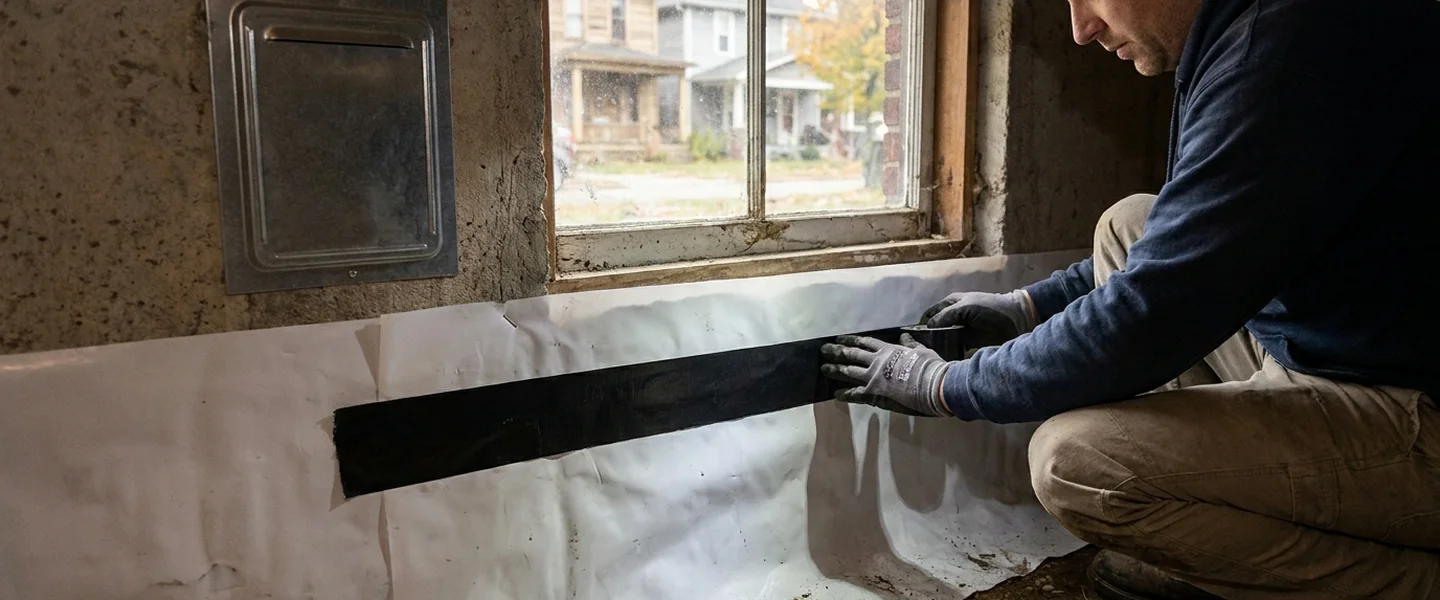
Encapsulation is a more comprehensive build that includes a heavy-duty reinforced vapor barrier (typically 20-mil), barrier coverage on the foundation walls (not just the floor), vent sealing, rigid foam insulation on the foundation walls, closed-cell spray foam at the rim joists, and an active commercial dehumidifier sized for the cubic footage. Encapsulation is essentially a closed crawl space taken to its complete, engineered form — a fully sealed thermal-and-moisture envelope.
In Practice the Industry Uses the Terms Loosely
That’s the textbook distinction. In real-world central Ohio quotes, the terms get mixed up — sometimes deliberately for marketing reasons. A contractor selling a basic closed-crawl-space package may label it “encapsulation” because the word sounds more substantial. A contractor selling a full encapsulation package may label it “closed crawl space” if they think the homeowner is sensitive to the higher-end terminology. The only way to know what you’re actually buying is to read the line items: vapor barrier brand and thickness, wall coverage scope, vent sealing approach, insulation scope, and whether there’s an active dehumidifier specified.
What Each Approach Delivers in Central Ohio’s Climate
A minimum closed crawl space (6-mil floor cover, vents sealed, HVAC supply air bleeding into the space) does provide measurable improvement over an open vented crawl space. The musty smell upstairs typically diminishes. The wood-moisture content of the framing drops several percentage points. The cooling bill drops modestly in summer. But several limitations apply in central Ohio: the 6-mil barrier degrades within 5-7 years in this climate, the HVAC supply approach doesn’t reliably hold humidity below 60% during peak summer (above the threshold for mold growth), and there’s no thermal envelope improvement at all because there’s no insulation in this scope.
A full encapsulation (20-mil reinforced barrier on floor and walls, vents sealed, rigid foam wall insulation, rim-joist spray foam, sized commercial dehumidifier) provides substantially more in central Ohio’s climate. The musty smell is fully eliminated within days. Wood-moisture content drops below 15% and holds there year-round. Humidity holds below 55% RH year-round, well below the 60% mold threshold. Heating bills drop 15-25% in winter due to the thermal envelope. Cooling bills drop 15-20% in summer. The materials carry 25-year warranties, and the workmanship is transferable.
When to Choose Which
For a Columbus-area homeowner who plans to stay in the home long-term and wants the durable fix, full encapsulation is almost always the right answer. The day-one cost premium over a minimum closed crawl space pays back through energy savings within 5-10 years, and the warranty terms are dramatically better.
For a short-hold scenario — a rental property the owner expects to sell within a few years, a flip property, a home being prepared for sale where the goal is to pass the inspection without major investment — a minimum closed crawl space can be a defensible compromise. We’ll quote both approaches when asked, and we’ll be honest about which one matches the homeowner’s actual situation.
Reading a Quote That Uses Either Term
Look past the headline term (“closed crawl space” or “encapsulation”) and read the line items. Specifically:
Vapor barrier: Is the thickness specified? Is it reinforced or unreinforced? Is the brand named? Does the coverage include walls or only floor?
Vent sealing: Are the vents sealed from inside with insulated covers, or just covered with screen cloth? Is the rim joist sealed?
Insulation: Is there any insulation in the scope? If yes, what type (rigid foam, spray foam, fiberglass), what R-value, and where is it being installed (walls, rim joists, both)?
Humidity control: Is there an active dehumidifier specified? Brand? Model? Capacity? Or is the quote relying on passive HVAC bleed?
Warranty: Length, transferability, exclusions, in plain English?
If a quote labels itself “encapsulation” but doesn’t include wall coverage, wall insulation, or an active dehumidifier, it isn’t really encapsulation by the industry’s strict definition — it’s a closed crawl space with marketing language attached. That’s not necessarily wrong, but you should understand what you’re buying.
Why the Distinction Matters in Central Ohio Specifically
Central Ohio’s humid summers push crawl space humidity above 60% RH (the mold-growth threshold) for 12-16 weeks every year without active dehumidification. A minimum closed crawl space that relies on HVAC bleed often doesn’t hold humidity below that threshold during peak summer, which means mold can still grow in the closed space — defeating part of the purpose. Full encapsulation with an active commercial dehumidifier holds humidity below 55% year-round, eliminating mold growth conditions entirely.
Central Ohio winters bring 35-50 freeze-thaw cycles annually, which cause foundation movement and mortar cracking in older homes (Worthington stone foundations, Upper Arlington brick-and-block hybrids). A minimum closed crawl space provides no thermal performance, so the freeze-thaw cycling continues to drive damage. Full encapsulation with rigid-foam wall insulation creates a thermal buffer that reduces (though doesn’t eliminate) the freeze-thaw impact.
Columbus-Specific Considerations
The age of central Ohio housing stock affects the choice. Pre-war homes (Worthington, Upper Arlington, Westerville Uptown) almost always benefit from full encapsulation because their original framing is more vulnerable to moisture and freeze-thaw effects. Newer subdivisions (Dublin, Hilliard, Gahanna) can sometimes get away with a closed crawl space approach because the original framing is more robust, though we still recommend full encapsulation for long-hold homeowners in those neighborhoods.
Common Misconceptions
“Closed crawl space is the same thing as encapsulation.”
Technically, no. Encapsulation is a more comprehensive build. In marketing, the terms get used interchangeably, which is why reading the line items matters more than the headline.
“If a quote says ‘encapsulation,’ the contractor is doing it right.”
Not necessarily. The word doesn’t guarantee the scope. Read the line items.
“A closed crawl space is good enough for Columbus’s climate.”
It’s better than an open vented crawl space, but it doesn’t reliably handle humidity during peak summer and provides no thermal performance. Full encapsulation is better suited to central Ohio’s climate.
“Encapsulation is overkill for a small house.”
The cubic footage of the crawl space drives the dehumidifier sizing, not the cost-effectiveness of the approach. Even small homes benefit from the full encapsulation envelope.
Bottom Line
The strict technical distinction is real: closed crawl space is the basic version, encapsulation is the complete engineered envelope. In real-world Columbus quotes, the headline terminology is unreliable — what matters is the line items. Call (614) 907-4875 for a free on-site inspection and a written quote that specifies every line item in plain English so you can compare quotes accurately.
Need a free inspection or a second-opinion quote review? Call (614) 907-4875. We serve Columbus and all surrounding Franklin County suburbs including Dublin, Westerville, Worthington, Hilliard, Upper Arlington, Grove City, Reynoldsburg, and Gahanna. Written estimates within 24 hours.
Related reading: Crawlspace Encapsulation Service Page | Crawlspace Mold Remediation Service Page | Dehumidifier Installation Service Page
Free Crawlspace Inspection in Columbus
Same-week appointments. No high-pressure sales. Serving Columbus and surrounding Franklin County suburbs including Dublin, Westerville, Worthington, Hilliard, Upper Arlington, Grove City, Reynoldsburg, Gahanna.