How Long Does Crawlspace Encapsulation Take in Columbus?
A central Ohio crawl space specialist’s guide.
- Licensed & Insured in Ohio
- Locally Owned, Columbus-Based
- 25-Year Warranty on Encapsulation
- Free On-Site Estimates
- 0% Financing Available
The most common question we get during inspection visits across central Ohio is “how long is the actual install going to take?” Homeowners want to plan around the work — work-from-home schedules, kids and pets, vacation timing, sequencing with other contractors on the property. The honest answer is that crawl space encapsulation timelines depend on five or six specific factors, but for the typical Columbus-area home, the install runs 2-4 days from start to finish. This post walks through exactly what happens on each day and what tends to push the timeline up or down.
Day 1: Demo, Prep, and Drainage Work
The crew arrives between 7:30 and 8:30 in the morning. They walk the crawl space with the homeowner one more time, photograph existing conditions for the install record, confirm any special instructions, and then the demolition starts. Old fiberglass insulation is pulled out and bagged. Any degraded prior vapor barrier (almost always 6-mil black polyethylene in central Ohio homes that haven’t been touched since the 1970s-1990s) is rolled up and hauled out. Debris and any prior installer’s leftovers go to the truck. If there’s standing water or active drainage scope, that happens here too — sump pumps confirmed running, perimeter drains trenched if specified. By end of day 1, the crawl space is empty, clean, and ready for the new install. Hours on site: 6-8 typically.
Day 2: Vapor Barrier Install and Wall Coverage
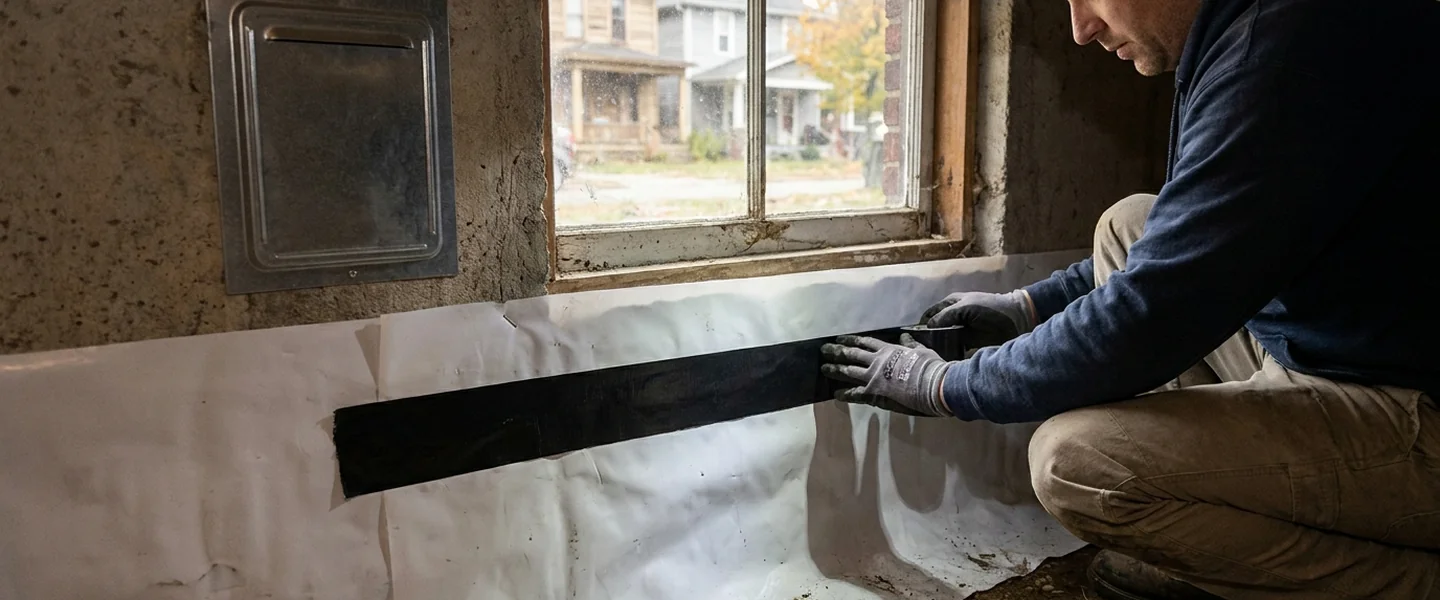
Day 2 is the heart of the install. The 20-mil reinforced Stego Wrap vapor barrier is laid across the soil, cut around piers, run 6-12 inches up the foundation walls, and mechanically fastened. Every seam is taped with manufacturer-approved butyl tape. Every pier — whether limestone in a 1925 Worthington bungalow or poured concrete in a 1992 Dublin colonial — is wrapped and sealed. Wall coverage continues with rigid foam board insulation (R-10 Owens Corning FOAMULAR) fastened to the foundation walls and sealed at all joints. Closed-cell spray foam goes at the rim joists. Hours on site: 8-10. By end of day 2, the crawl space is a sealed envelope, top to bottom.
Day 3: Dehumidifier, Vent Sealing, and Commissioning
Day 3 is the mechanical work. The foundation vents are sealed from the inside with insulated covers, eliminating the stack effect that drives outdoor humidity in. The commercial dehumidifier (Aprilaire 1820 or Santa Fe Compact70, sized for your cubic footage) is hung from the floor joists with vibration-isolating mounts, plumbed for permanent condensate drainage to a sump or exterior, and wired to a dedicated 110V circuit. On larger crawl spaces (above ~2,500 sq ft) we add a short flex-duct return so the unit pulls air from the far corner of the space. Then it’s commissioning: full cycle test, condensate drain verification, humidistat setpoint, and final humidity readings. Hours on site: 4-6 typically.
Day 4 (When Needed): Structural and Finish Work
If the scope includes structural work (Smart Jack supports on poured footings, sister-beam reinforcement), that happens here. Concrete footings poured on day 1 are now adequately cured and ready to receive vertical load — the adjustable steel supports go on, plumbed, snugged up against the existing beam. Any remaining finish work — sealing the access door, final caulking, paint or seal on exposed wood, putting away tools — happens on day 4. Final walkthrough with the homeowner closes the install. Hours on site: 4-8 depending on the structural scope.
What Adds Days to the Timeline in Central Ohio
Drainage work. If the inspection found bulk water entry and we need to install perimeter French drainage or a primary-plus-backup sump pump system — common in Gahanna along Big Walnut Creek and in low-lying parts of Westerville and Reynoldsburg — that’s typically an extra day before the vapor barrier goes down.
Major structural repair on poured footings. Concrete footings need 24-72 hours to cure before any vertical load is applied. If your job includes new structural supports on poured footings, that’s a built-in delay between day 1 (footings poured) and day 4 (supports loaded). We can usually overlap other scope during the cure time.
Active mold remediation. If the inspection found significant mold growth and we’re remediating before encapsulation, plan for 1-2 extra days of containment setup, material removal, antimicrobial treatment, and HEPA vacuuming.
Multi-section crawl spaces. Homes with additions added over the decades (very common in Worthington, Upper Arlington, and Westerville Uptown) sometimes have multi-section crawl spaces with internal foundation walls that need separate detailing per section. These jobs often run a day longer than tract-home jobs.
Tight access. 1920s-1940s housing in Worthington Old Town, Upper Arlington pre-war Tudors, and Westerville Uptown bungalows often has 18-22 inch clearances that slow material handling considerably. Plan for 1 extra day on these jobs.
Asbestos abatement coordination. Some 1950s-1960s eastside Reynoldsburg and Grove City homes have asbestos pipe insulation on the cast-iron drain stack that needs to be abated by a licensed abatement contractor before our work can begin. We coordinate with a partner abatement firm; their work typically adds 1-2 days to the front of the schedule.
What Doesn’t Add Days
Weather almost never adds days. We work year-round in central Ohio, and the crawl space itself is naturally buffered from outdoor temperatures even before the install starts. The one exception is concrete footing pours during sustained sub-freezing weather, which we schedule around but rarely have to delay more than a few days during a typical Columbus winter.
Permitting almost never adds days when we handle it. Most central Ohio building departments turn around crawl space permit applications within 5-10 business days, and we apply at the same time we deliver the quote so the permit is in hand by the scheduling window.
Final inspections by the building department, where required, happen within a few business days of install completion and rarely affect the homeowner’s experience of the timeline.
Columbus-Specific Considerations on Timeline
The central Ohio housing stock varies enough that two seemingly similar jobs can have very different timelines. A 1992 Dublin tract crawl space with 36 inches of clearance and exterior at-grade access can complete in 2 days. A 1925 Worthington bungalow with 22 inches of clearance, an interior closet hatch, multi-section construction, and an asbestos pipe wrap discovery can take 5-6 days once abatement coordination is factored in. The inspection visit tells us which scenario applies to your home, and the written quote gives you a day-by-day schedule rather than a vague range.
Questions to Ask About Your Timeline
- How long is the actual install on site, day by day?
- Does that timeline include drainage scope, mold remediation, or structural work, or are those separate phases?
- What happens if you discover something unexpected on day 1 — do you finish in the same window or extend?
- How soon after acceptance can you start?
- When do the 30-day and 12-month follow-up visits happen?
Common Misconceptions About Encapsulation Timeline
“It should just take one day if you’re efficient.”
A proper 2,000 sq ft encapsulation in a typical central Ohio crawl space has too much scope to compress into one day if it’s done correctly. Demo alone is usually a full day in older homes. Anyone who promises one-day completion is either skipping scope or assuming a tract-home best case.
“It should take weeks because crawl spaces are complicated.”
2-4 days is the typical window. Multi-week timelines suggest either a multi-trade scope (asbestos abatement, major drainage, structural reconstruction) or a contractor who isn’t focused on this work as their primary line of business.
“I have to leave the house during the work.”
Not for a normal encapsulation install. The crawl space is sealed from the conditioned living space by the existing sub-floor, and most Columbus-area homeowners go about their normal lives during the work. Exceptions: large-scale mold remediation or asbestos abatement, where containment requirements may temporarily limit access to certain areas.
“Weather will delay everything.”
It almost never does. Crawl space work is interior work by definition, and the only weather-sensitive piece is concrete cure time, which is a small part of overall timeline.
Bottom Line
For a typical central Ohio home, plan on 2-4 days of install work for full encapsulation. The written quote will give you a day-by-day breakdown specific to your scope so you can plan family schedule, work-from-home arrangements, and any other contractor sequencing on the property. Call (614) 907-4875 for a free 30-minute on-site inspection and a written, day-by-day install schedule within 24 hours.
Need a free inspection or a second-opinion quote review? Call (614) 907-4875. We serve Columbus and all surrounding Franklin County suburbs including Dublin, Westerville, Worthington, Hilliard, Upper Arlington, Grove City, Reynoldsburg, and Gahanna. Written estimates within 24 hours.
Related reading: Crawlspace Encapsulation Service Page | Crawlspace Mold Remediation Service Page | Dehumidifier Installation Service Page
Free Crawlspace Inspection in Columbus
Same-week appointments. No high-pressure sales. Serving Columbus and surrounding Franklin County suburbs including Dublin, Westerville, Worthington, Hilliard, Upper Arlington, Grove City, Reynoldsburg, Gahanna.