Why Columbus Crawl Spaces Sag (and How to Permanently Fix Them)
A central Ohio crawl space specialist’s guide.
- Licensed & Insured in Ohio
- Locally Owned, Columbus-Based
- 25-Year Warranty on Encapsulation
- Free On-Site Estimates
- 0% Financing Available
Sagging floors in central Ohio homes are one of the most common reasons Columbus homeowners call us. The floor in the living room bounces. A piece of furniture rocks that didn’t before. A door catches when it didn’t catch a year ago. The kitchen floor has a noticeable downward slope toward one wall. These are all signs that something in the crawl space below is moving — and the longer you wait, the more expensive the fix becomes. This guide explains why Columbus-area crawl spaces sag and what the permanent fix actually looks like in central Ohio’s housing stock and soil conditions.
The Three Reasons Columbus Crawl Spaces Sag
In our inspection experience across Franklin County, sagging floors over crawl spaces almost always trace back to one of three causes — and often to a combination of two or three working together over decades.
Reason 1: Original Pier Settlement into Glacial Till
The dominant cause across pre-1970 Columbus housing stock. The original builders set piers — limestone, brick, CMU, or in some cases just stacked-stone — directly onto excavated glacial till. Glacial till is a heterogeneous soil composed mainly of clay with embedded gravel, sand lenses, and cobbles deposited by the Wisconsin glaciation. It has highly variable bearing capacity from one point to another, and over decades the clay component compresses and settles under load while the gravel and cobble component doesn’t.
The result is differential settlement: one pier drops half an inch over twenty years, the adjacent pier drops a full inch, and a third pier doesn’t move at all. The main beam above sags between the high and low piers, and the floor system above the beam follows. The settlement is permanent — the soil isn’t going to spring back — but the symptoms can be corrected by adding new adjustable supports on properly engineered footings that bypass the original problem soil.
Reason 2: Wood Decay from Long-Term Moisture Exposure
The second-most-common cause in central Ohio housing stock. Original wood framing (sills, beams, joists) in an unsealed crawl space cycles between humid summer conditions (70-80% RH for 12-16 weeks) and damp winter conditions (snowmelt soaking the soil under the crawl space for 6-10 weeks in spring). Wood at sustained moisture content above 19% becomes vulnerable to fungal decay. Wood at sustained moisture content above 25% will rot within a few years.
The decay is rarely visible from above. The home inspector walking the upstairs floors doesn’t see it. The homeowner doesn’t see it. Then one day the kitchen floor flexes more than it used to, or a portion of the dining room sub-floor cracks during a furniture move, and the inspection reveals a beam with a rotted center section or a joist that’s lost half its cross-section to fungal damage. The fix here is sister-beam reinforcement — a new pressure-treated or LVL beam installed alongside the damaged original, mechanically fastened with structural through-bolts at engineered spacing.
Reason 3: Undersized Original Framing
The third cause is most common in 1900s-1940s housing stock in Worthington, Upper Arlington, and Westerville Uptown — homes built before modern engineered framing standards. Builders of that era typically used the framing that was locally available (often Eastern white pine or hemlock) at spans and spacings that wouldn’t pass a modern code inspection. The framing was adequate for the loads of the day — lighter furnishings, lighter appliances, fewer occupants — but as families filled the homes with heavier modern loads, the original framing has been gradually overstressed.
The symptom is a gradual increase in floor deflection over decades, with no specific failure event. The fix here is usually new interior support — adjustable steel posts on poured footings, placed at intermediate points along the main beam to reduce the effective span — rather than full beam replacement.
What the Permanent Fix Looks Like in Central Ohio
For any of the three failure modes above, the permanent fix involves four elements:
1. Poured concrete footings sized to the load. The original piers in Columbus-area pre-1970 homes were almost universally undersized for the load by modern standards. New footings are sized to local code minimums and to the bearing capacity of central Ohio glacial till at the depth being used. A properly sized footing is the foundation (literally) of a permanent fix.
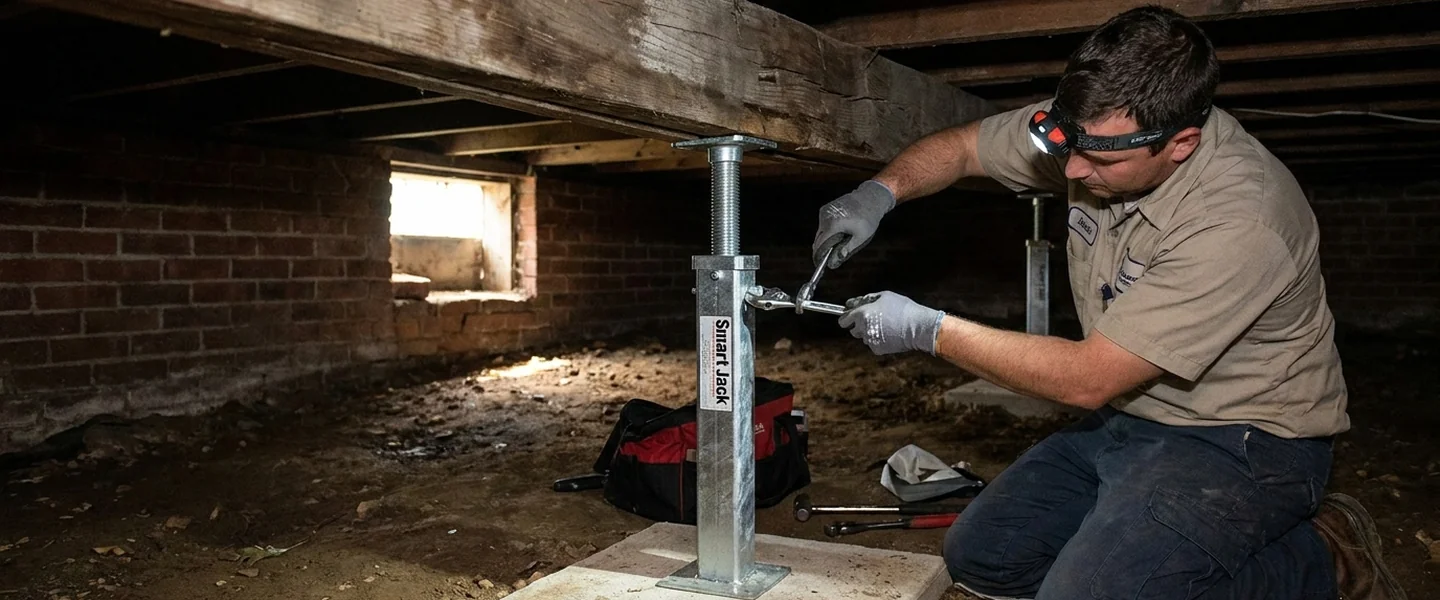
2. Adjustable steel Smart Jack supports on the new footings. Smart Jacks are engineered, adjustable steel supports that allow the installer to precisely set the height during install and then incrementally adjust upward over time as the floor is re-leveled. They are corrosion-resistant for crawl space use, they accommodate minor future movement without binding, and they carry a limited lifetime manufacturer warranty.
3. Sister-beam reinforcement where the original framing is compromised. Where the original beam shows rot, splits, or notching that compromises its load capacity, we sister a new pressure-treated or LVL beam alongside it, mechanically fastened at engineered spacing. The original beam stays in place — we don’t try to remove it — and the new beam carries the load.
4. Slow, incremental re-leveling over 7-14 days. Once the new supports are in place and load is being transferred from the original piers, we return every few days to incrementally turn the adjustable supports upward, bringing the floor system back toward level a fraction of an inch at a time. Doing this slowly avoids drywall cracking in the rooms above, avoids door-frame deformation, and avoids cracking grout lines in tile floors.
What the Fix Doesn’t Look Like
It doesn’t look like jacking the floor up to level in a single visit. Doing that breaks drywall, cracks tile, deforms door frames, and creates more visible damage than it fixes.
It doesn’t look like injecting some kind of foam or expanding chemical to “lift” the floor. There are products marketed this way; they don’t work for crawl space pier settlement, and any contractor proposing them is selling marketing rather than engineering.
It doesn’t look like adding “extra” piers without removing them from the original load path. Adding a support next to an existing pier without transferring load doesn’t fix the problem — it just adds material.
Cost Drivers for Structural Repair in Central Ohio
We won’t quote a number here because every job is different, but the major scope drivers are: number of new footings required (more piers = more concrete and more steel), depth of footings (deeper for poor bearing soil), need for beam reinforcement (sister beams add material and labor), access (tight crawl spaces in Worthington pre-war homes slow the work), and whether drainage or moisture work needs to happen at the same time. The free 30-minute on-site inspection identifies all of these factors, and the written quote breaks them out so you can see what’s driving the price.
How Long the Structural Work Takes
Most central Ohio structural repair jobs run 1-3 days on site, with the floor re-leveling happening over a follow-up 7-14 day period after install. The breakdown is typically: day 1 to pour footings (concrete needs 24-72 hours to cure), day 2 to install adjustable supports, day 3 if needed for beam reinforcement. Then return visits every few days for the incremental re-leveling adjustments.
Columbus-Specific Considerations
The mix of housing eras in the Columbus metro means the failure mode varies dramatically by neighborhood. Worthington and Upper Arlington pre-war homes typically combine all three failure modes — pier settlement plus wood decay plus undersized original framing. Westerville Uptown bungalows usually show pier settlement and undersized original framing. Newer Dublin and Hilliard subdivisions occasionally show pier settlement on cut-and-fill lots but rarely show wood decay or undersized framing. The inspection visit identifies which scenario your home matches and what scope is actually needed.
Questions to Ask About Structural Repair
- How many new footings will you install, and what size are they?
- What adjustable supports do you specify by brand and model?
- Do you sister-beam where the original framing is compromised, or do you only add supports?
- How do you re-level the floor — single lift or incremental over time?
- Is the workmanship warranty transferable to a new homeowner?
- Can you provide references from Columbus-area structural repair jobs in the past 12 months?
Common Misconceptions About Sagging Floors
“It’s just cosmetic, I can live with it.”
Sagging floors often indicate progressing structural damage. Living with the symptom usually means the underlying problem gets worse, and the eventual fix gets more expensive.
“All sagging floors mean foundation problems.”
In central Ohio, most sagging floors over crawl spaces trace to pier settlement, wood decay, or undersized framing — none of which are technically “foundation problems” in the underpinning sense. The full-foundation underpinning that most homeowners imagine when they hear “foundation problems” is rarely necessary for crawl space pier issues.
“It’ll fix itself if I dehumidify the crawl space.”
Dehumidification is essential for preventing future damage, but it doesn’t reverse existing settlement or wood decay. The structural fix and the moisture work are separate scopes that often happen together.
“I should jack it up to level all at once.”
Don’t. Single-lift adjustments crack drywall, tile, and door frames. Incremental adjustment over 7-14 days is dramatically safer for the rooms above.
Bottom Line
Sagging floors over a Columbus-area crawl space are almost always fixable, and the fix is usually permanent. The right answer is a free on-site inspection that identifies the actual failure mode (settlement, decay, or undersized framing), followed by a written quote that specifies footing size, support brand and model, beam reinforcement scope, and timeline. Call (614) 907-4875 to schedule a free 30-minute inspection.
Need a free inspection or a second-opinion quote review? Call (614) 907-4875. We serve Columbus and all surrounding Franklin County suburbs including Dublin, Westerville, Worthington, Hilliard, Upper Arlington, Grove City, Reynoldsburg, and Gahanna. Written estimates within 24 hours.
Related reading: Crawlspace Encapsulation Service Page | Crawlspace Mold Remediation Service Page | Dehumidifier Installation Service Page
Free Crawlspace Inspection in Columbus
Same-week appointments. No high-pressure sales. Serving Columbus and surrounding Franklin County suburbs including Dublin, Westerville, Worthington, Hilliard, Upper Arlington, Grove City, Reynoldsburg, Gahanna.